The Hidden Cost of Manual Fleet Tracking
PaxPilot Team
February 11, 2026 · 8 min read
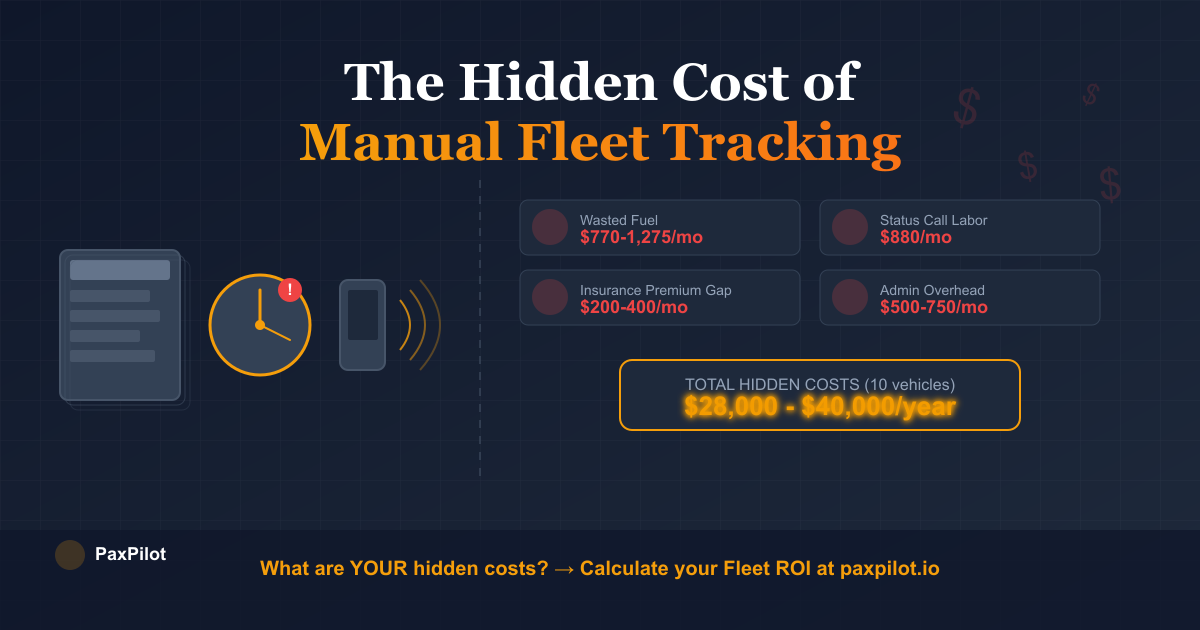
The Hidden Cost of Manual Fleet Tracking: What Spreadsheets and Whiteboards Are Really Costing You
You might think you're saving money by avoiding fleet management software. The truth? Manual tracking is quietly draining your operation of thousands—sometimes tens of thousands—of dollars every month.
Picture this: It's 7:45 AM on a Tuesday. A parent calls your office in a panic. Their daughter didn't arrive at school, and they need to know—right now—whether she's on the bus. Your dispatcher scrambles to call the driver (who doesn't pick up because they're driving), checks a paper manifest that's still sitting on yesterday's clipboard, and finally radios someone who thinks they remember seeing her board... maybe.
Fifteen minutes of chaos later, you confirm the student is safe. But that fifteen minutes? It cost you more than just stress.
This scenario plays out hundreds of times daily across school districts, medical transportation providers, charter companies, and senior living communities. Each instance represents a hidden cost that never shows up on a line item—but absolutely shows up in your bottom line.
Let's pull back the curtain on what manual fleet tracking really costs.
1. The Liability Time Bomb
Here's a number that should make every fleet operator pause: $2.3 million. That's the average jury award in child transportation injury cases according to the National School Transportation Association.
When your only record of a pickup is a driver's signature on a paper manifest, you're building your defense on sand. Consider what happens when a parent claims their child was dropped at the wrong location, or when a medical transport patient alleges they were left waiting in the heat. Without timestamped, GPS-verified records, your word becomes your only defense.
Insurance carriers have noticed. Fleets without digital chain-of-custody documentation now pay 15-25% higher premiums than those with verified tracking systems. That's not a statistic from a software vendor—it's data from commercial auto insurers who've calculated exactly how much more risk manual operations carry.
The hidden cost: Every day you operate without digital verification, you're accumulating liability exposure that could devastate your business in a single lawsuit.
💡 Quick Assessment: When was the last time you could prove, with timestamp and GPS coordinates, exactly when and where a passenger was picked up or dropped off? If you can't answer that in under 30 seconds, you have a liability gap.
2. The Fuel Money Drain
Your drivers know their routes. They've been running them for years. So why would software do it better?
Here's why: the human brain isn't designed to solve what mathematicians call the "traveling salesman problem"—optimizing the sequence of multiple stops to minimize total distance. When you add real-world constraints like time windows, vehicle capacity, traffic patterns, and accessibility requirements, the complexity explodes exponentially.
A 10-vehicle fleet driving an average of 80 miles per vehicle per day burns through 1,467 gallons of fuel monthly at typical MPG rates. At $3.50 per gallon, that's over $5,100 in monthly fuel costs.
Route optimization software consistently delivers 15-25% fuel savings by eliminating inefficient sequencing, reducing deadhead miles, and adapting to real-time traffic conditions. For our 10-vehicle example, that's $770-$1,275 saved every month—money that's currently going straight out your exhaust pipe.
The hidden cost: Your experienced drivers are doing their best, but they're competing against mathematics they can't win. Every gallon wasted is profit evaporated.
3. The "Where's My Child?" Tax
How many phone calls does your dispatch team field each week from worried parents, anxious family members, or facilities wondering when their passenger will arrive?
For school transportation providers, the answer is often dozens per day. Each call typically consumes 3-5 minutes of staff time: answering, looking up information, making radio calls to drivers, and calling back with updates.
Let's do the math on a modest estimate of 30 calls per day:
- 30 calls × 4 minutes average = 120 minutes daily
- 120 minutes × 22 operating days = 2,640 minutes monthly
- 2,640 minutes = 44 hours of staff time per month
At $20/hour, that's $880 monthly in direct labor costs. And that doesn't account for the opportunity cost—what productive work could your dispatch team accomplish if they weren't playing phone tag?
Real-time tracking portals where parents and family members can check status themselves don't just improve satisfaction. They eliminate this entire cost category.
The hidden cost: You're paying someone to answer questions that technology could answer automatically, 24/7, with zero hold time.
4. The Invisible Administrative Burden
Ask any fleet manager how they spend their time, and "paperwork" rarely makes the highlight reel. Yet manual operations create an administrative undertow that pulls hours from every week.
Consider what manual fleet tracking actually requires: creating paper manifests, collecting and filing driver logs, manually entering trip data for billing, chasing down missing signatures, compiling compliance reports, and reconciling discrepancies between what drivers reported and what actually happened.
For NEMT providers, this burden is particularly brutal. Manual trip documentation is the #1 cause of claim denials, with the industry averaging a 12-15% denial rate. Each denied claim requires investigation, correction, and resubmission—administrative work that generates zero revenue.
One NEMT operator we spoke with calculated their administrative time at 4-6 hours weekly per dispatcher just for documentation tasks that would be automated by proper fleet management software. With three dispatchers, that's 12-18 hours weekly—essentially a part-time employee doing nothing but paperwork.
The hidden cost: Your most valuable staff members are spending their time on tasks that computers do better, faster, and without errors.
5. The Missed Opportunity Multiplier
Here's the cost that's hardest to quantify but potentially the largest: what you can't do because you're stuck in reactive mode.
When every day is consumed by putting out fires—tracking down buses, resolving pickup confusion, handling complaints—there's no bandwidth left for growth. You can't pursue that contract with the school district across town. You can't respond quickly enough when a senior living community needs emergency transportation coverage. You can't scale your NEMT operations because adding vehicles would overwhelm your already-strained processes.
Manual operations create a ceiling. They limit you to the number of vehicles and routes that your team can physically keep track of using whiteboards, paper manifests, and institutional memory.
Meanwhile, your competitors who invested in fleet technology are taking on new contracts, expanding into adjacent territories, and building the operational infrastructure for growth.
The hidden cost: Every month you wait, the gap between your capabilities and the market's expectations widens.
What These Hidden Costs Actually Add Up To
Let's tally a conservative estimate for a 10-vehicle fleet:
| Hidden Cost Category | Monthly Impact |
|---|---|
| Insurance premium differential | $200-400 |
| Fuel waste from unoptimized routes | $770-1,275 |
| Staff time on status calls | $880 |
| Administrative documentation burden | $500-750 |
| Total Monthly Hidden Costs | $2,350-3,305 |
That's $28,000-40,000 annually in costs that don't appear on any invoice but are absolutely draining from your operation.
For larger fleets, multiply accordingly. For NEMT providers with claim denial issues, add another 12-15% of your monthly revenue. For organizations that have faced or settled liability claims, the numbers become significantly more sobering.
The Path Forward
The goal of this article isn't to make you feel bad about how you currently operate. Many successful transportation providers have built good businesses using manual methods. The question is whether those methods can sustain you into the future—and at what cost.
Modern fleet management platforms now offer capabilities that were enterprise-only luxuries just a few years ago: real-time GPS tracking, digital chain-of-custody verification, automated route optimization, family notification portals, and compliance documentation that happens automatically.
The economics have shifted. When the software pays for itself through fuel savings alone—and that's before counting liability reduction, administrative efficiency, and growth enablement—the calculation becomes straightforward.
Ready to see what your hidden costs actually are?
We've built a free Fleet ROI Calculator that helps you quantify exactly what manual operations cost your specific operation. No sales pitch required—just honest numbers based on your fleet size and current processes.
→ Calculate Your Hidden Fleet Costs
PaxPilot is a fleet management platform built specifically for specialized transport operators serving schools, medical facilities, charter services, and senior communities. We're currently welcoming beta partners who want to eliminate hidden costs while improving safety and service quality.
Tags:
Ready to streamline your fleet operations?
Join fleet managers who are saving time and keeping passengers safe with PaxPilot.
Join the Waitlist